Orifice Flow Calculation
Calculating an Orifice Diameter
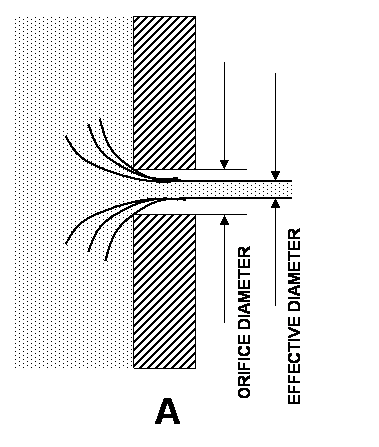
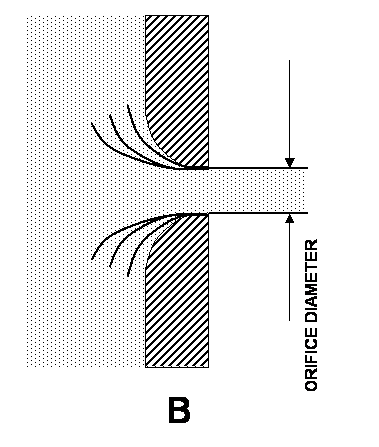
It is difficult to accurately calculate the flow of a gas or liquid through a tiny orifice due to the effect of the leading edge of the orifice. In the case of a sharp-edged orifice, the effective diameter is 0.65 times the actual diameter. However, in the case of an orifice whose leading edge is rounded with a radius roughly equal to that of the orifice itself, the factor is approximately 1.0. This factor, which can vary between 0.65 and 1.0 is known as the orifice coefficient. As the flow of any fluid through an orifice is proportional to the square of the diameter, the flow is reduced by up to (0.65) = 44% depending on the shape of the leading edge. Figure A below shows flow through a sharp-edged orifice, and figure B the flow through a rounded orifice as previously described.
Due to the number of factors involved, the preferred method of arriving at the required orifice diameter for a given restriction is to estimate the approximate diameter and then carry out a meaningful set of tests using a range of orifices with diameters around that estimated. Note that these test orifices should all have the same leading-edge characteristics. From the results of the test, a constant can be derived that will be applicable for the particular set of circumstances and units. For example, if a pressure management point is moved on a gas flow test rig a different constant might have to be established because pressure varies throughout a moving gas in an irregular channel.
It is easy to measure the diameter of
an orifice but almost
impossible to measure the leading edge radius on a tiny
orifice with normally available equipment
Formulae for Liquid Flow
For liquids where the pressure at the orifice is known in units of length (head),

where Q is the mass flow rate in units of mass/time, D is the orifice diameter in units of length and h is the head also in units of length.
For liquids where the pressure at the orifice is known in units of pressure,

where Q is the mass flow rate in units of mass/time, D is the orifice diameter in units of length and P is the pressure in units of mass/(length)squared.
Note that the units for the constant, although not relevant, are different for units of pressure and for units of head.
Formulae for Gases
There are two sets of circumstances for gas flow depending on whether the gas flow is subsonic or supersonic. Supersonic flow is independent of downstream conditions because pressure waves cannot travel upstream at greater than the speed of sound. Airflow is supersonic when the absolute upstream pressure is greater than 1.89 x the absolute downstream pressure.
For supersonic gas flow,

where Q is the mass flow in units of mass/time, D is the orifice diameter in units of length, P1 is the upstream pressure in units of mass/length_squared, and T1 is the upstream absolute temperature in whichever temperature scale is chosen.
There is a wide variety of formulae developed for subsonic gas flow. For example,

Rather than use this or any other unwieldy equations and because assumptions would have to be made, the simple solution is to use the supersonic forumla and allow for a reduction in flow when making the initial guess.
Summary |
Formula to derive constant |
Formula to calculate flow |
Liquids where head is known |
 |
|
Liquids where pressure is known |
 |
|
Supersonic gas flow |
 |
|